
Lace Making
One Lady's Industry

Abigail Barrett grew up in the time between the wars. Born during the American Revolution, she was far too young to have gone into lacemaking for the reasons her mother would have. During the war, women of high social and economic standing still wanted their lace (ready-made and imported), but the embargoes prevented the purchase of the fine French, Flemish, and Brussels laces they so adored.
Many women and girls knew how to make lace, but it was only when the wealthy women got desperate that the opportunity for profit in the traditional British cottage industry bloomed in New England. In England, lacemaking was associated with poor relief, but the war changed things in the New World. Patriotic women banded together in support of the war by making things that had once been easily imported. This took the stigma away from making lace to sell.
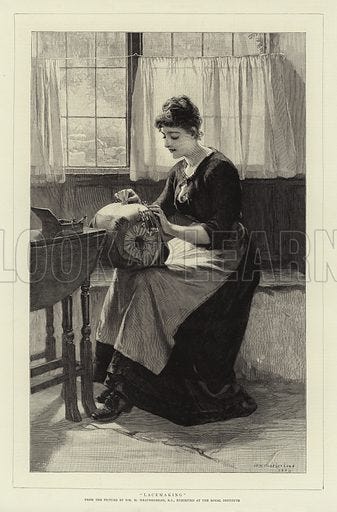
After the war, when times were still unstable economically, a woman could discreetly supplement her family’s income by making lace and selling it at market. In fact, lacemaking became a family affair, with the elderly and young children picking up the simple tools, too. In this way, even the slightly wealthier families could “employ” their daughters without shame.
As a direct descendant of Abigail, I’m fascinated by the stories my family has told me about her and plan to feature her in my next novel. Her family was not wealthy, but they were respectable. I don’t know when Abigail first started making lace. At the peak of cottage industry lace making, she would have been a young married woman. She and her husband, my grandfather Daniel Foster, had just moved to New Hampshire. Here they were invited into the best families’ homes, because despite their lack of wealth, they presented as an elegant couple (and the women admired Abigail’s fine talent).
In those days when drinking in America was at its peak, Daniel, a master cooper and much sought after for his work, became a slave to the bottle. I have no idea how quickly it came upon him—was it a slow and steady habit nursed since childhood when his father and older brothers spent years away at war? Or did the death of his first love to sudden illness break his heart? We may never know. But I can imagine him making sad excuses for his family’s descent into poverty.
Abigail worked herself sick. Daniel scolded her and begged her to stop, but she was determined to keep her children in the little luxuries they had been accustomed to. Their eldest son was educated and left them before things got too bad, but Charles Foster bore the brunt of his father’s negligence. By the time he was five years old, he was bound out to work. After his younger sister Susanna died, he was given a brief respite before being sent out repeatedly for most of his childhood.
When Charles moved to Cortland County, New York, he brought his mother and sister Fanny with him—not his father. Daniel arrived later at some point. No one seems to know whether he’d sobered up by then or not.
I’m sure there were many women who worked their fingers to the bone making lace to avoid poverty.
But as the acceptance and popularity of American lace grew, so did the interest in mechanizing the process. By the 1830s, the production of handmade lace was already in decline. The intricate network of lace makers and the ability for these people to make decent money at their craft were quickly becoming things of the past.
The truly talented lace makers were probably still sought out by the older matrons of the revolutionary and post-revolutionary period, but the future was mechanized. Now men ran machines and women did the finishing work of lace called “flowering”.
My grandmother had been known not only for her lace but also for the finely woven thread and fabric she made from wool and flax. All these skills were eventually lost to the machine. In old journals, it’s mentioned that my aunts went to Abigail’s house to use her loom in the 1840s. As with all change back then, new ways of doing things came slowest to remote rural areas. Abigail had left the elite circles of her youth—possibly fleeing the shame of poverty and an alcoholic husband.
Her true story remains mostly hidden. Maybe she was relieved to grow old with a faithful son and his pious wife to worry about things. Maybe her fingers ached from years of work she was happy to forget. Or maybe she looked back with quiet pride at all she had accomplished despite hardship.
I hope to go into more depth on this topic in my next novel about the lifelong friendship of my grandmother and aunt, set in 1800s New York. Next week I’ll be sharing a first look at the early work-in-progress.
I’d love to read about the women in your family history! Please share in the comments.
For further reading:
The Laces of Ipswich by Marta Cotterell Raffel
As someone who has crocheted all my life, including thread crochet, I'm in awe of the even finer and more detailed skills of lacemaking and tatting. And how wonderful that you have such personal sources as old journals and family stories to tell you the details of your ancestors' lives. I've mostly had to glean what details I know about mine from census records and newspapers. I do know that many women *and* men in almost all branches of my family worked in Troy's famous collar and shirt factories in the early 20th century.